
Scenario questions are the point where ISO 27001 Lead Auditor preparation becomes real. A definition question asks what you know. A scenario question asks whether you can behave like an auditor when the evidence is incomplete, the auditee is confident, and two options sound almost correct.
The strongest candidates do not rush into answer selection. They build a small audit file in their head. What is the requirement? What is the sample? What is objective evidence? What is only opinion? What would a professional auditor do next?
Why scenario questions feel hard
Most difficult Lead Auditor questions are designed around tension. The organization has a policy but no record. The supplier has a certificate but the shared responsibility is unclear. The manager gives a confident explanation but the sample shows exceptions. The candidate must separate comfort from evidence.
This is why the best answer is often not the most technical answer. It is the answer that preserves auditor independence, tests evidence, follows the audit plan, respects confidentiality, and avoids consulting.
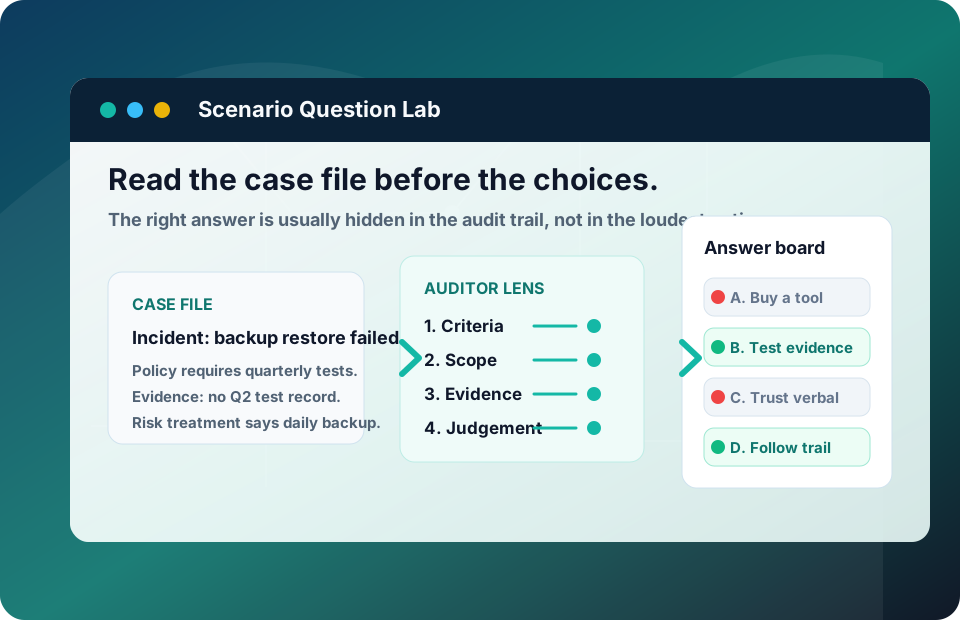
Use the five-lens method
Before selecting an answer, read the scenario through five lenses. This works for single-answer, multi-select, matching, and sequencing questions.
Criteria
Identify the requirement: ISO 27001 clause, policy, procedure, contract, legal obligation, SoA statement, or risk treatment plan.
Scope
Check whether the asset, supplier, process, site, cloud service, or timeframe is inside the audit scope.
Evidence
Separate objective evidence from verbal assurance, assumptions, screenshots without context, and unsupported management claims.
Judgement
Decide whether the evidence supports conformity, nonconformity, partial evidence, wider sampling, or escalation.
Auditor action
Select what an auditor should do next, not what a consultant, system owner, vendor, or investigator might do.
The seven traps hidden in hard questions
Creative scenario questions usually include attractive wrong options. The wrong option may sound strong, but it fails one audit principle.
Buy this SIEM or deploy this product turns the auditor into a consultant.
A confident interview answer is useful, but it normally needs corroborating evidence.
ISO 27001 is risk-based. Not every Annex A control is automatically mandatory.
A serious issue outside the audit scope may require reporting through agreed channels, but it may not be the finding asked by the question.
Nonconformities are about failure to meet requirements, not naming a person to blame.
One neat screenshot does not prove population completeness, operating period, or control effectiveness.
Not every gap is automatically major. Grading depends on systemic impact, risk, and intended outcomes.
How to handle multi-select and fractional scoring
In KISCyber practice papers, multi-select questions use proportional marks. If a two-mark question has three correct options, each correct option carries two-thirds of a mark. If a one-mark question has two correct options, each correct option carries half a mark.
That scoring model rewards disciplined reading. Do not choose an option only because it uses familiar words. Treat each option as a separate audit assertion and ask whether it is supported by the case facts.
A mini scenario: solve it slowly
Scenario: A cloud service provider shows a supplier ISO 27001 certificate and says this proves all backup controls are effective. The ISMS scope includes the SaaS production platform. The SoA includes backup and logging controls. The last restoration test record is eight months old, although the procedure requires quarterly restoration tests.
Question: Which auditor action is most appropriate?
- Accept the supplier certificate as full evidence of backup effectiveness.
- Recommend a specific backup product.
- Follow the audit trail through scope, SoA, procedure requirements, restoration test records, and supplier responsibility boundaries.
- Raise a major nonconformity immediately without checking the sample context.
Best answer: Option 3. It respects scope, criteria, objective evidence, and professional audit action. The certificate may be supporting evidence, but it does not automatically prove the organization's retained responsibilities or operating control evidence.
For sequencing questions, protect the audit order
Sequencing questions test professional discipline. For example, the right order for a finding is not write the report, then find the requirement. It usually starts with criteria, then evidence, then evaluation, then finding wording, then communication and follow-up.
When the options include similar steps, look for dependency. You cannot judge a nonconformity before identifying the requirement. You cannot close a corrective action before checking implementation and effectiveness evidence.
What better practice questions should look like
Easy questions ask, what does ISO 27001 require? Better questions give candidates a messy audit situation and ask them to choose the defensible auditor response.
For future KISCyber sets, the stronger question style will include:
- Evidence packets: policy extract, ticket sample, log screenshot description, interview statement, and exception record.
- Conflicting statements: management says one thing, records show another, and the auditor must decide what to test next.
- Supplier and cloud ambiguity: certificates, shared-responsibility boundaries, and retained organizational controls.
- Partial evidence: enough to continue the audit trail, but not enough to jump to a conclusion.
- NCR writing judgement: choosing the wording that has requirement, evidence, and failure without blame or advice.
- Multi-select pressure: options where two are correct, two are tempting, and one is technically true but outside scope.
A 20-minute daily drill
Use this short routine when you are preparing between full practice papers.
- Five minutes: revise one ISO 27001 clause or audit concept.
- Five minutes: write one audit criterion and three pieces of evidence you would test.
- Five minutes: answer three scenario questions without looking at explanations.
- Five minutes: classify mistakes as criteria error, evidence error, scope error, role error, or timing error.
References
Useful official references for confirming the standards and exam structure: